Describe your air conditioner job, and a local pro who handles it gets in touch.
Your AC quit on a warm Minnesota afternoon and now you're deciding what to do next. Summers here don't bring the heavy air some places get, but a house with no cooling still gets uncomfortable fast, especially if this stretches into days.
First, check the simple things. Look at your thermostat and make sure it's set to cool and the batteries aren't dead. Check your breaker panel for a tripped breaker. If your outdoor unit has a filter or the indoor coil access panel is nearby, see if airflow is blocked by anything obvious. None of this takes long, and it rules out the easiest answers before you wait on anyone.
If the unit still won't run, or it runs but isn't cooling, it's time for a contractor to look at it. This isn't something to leave for a week. A system that's struggling or dead can mean a refrigerant leak, a failed capacitor, or a motor that's given out, and none of those get better on their own.
What happens next isn't on you to figure out. Once you send the request, a contractor who works on air conditioners in your area gets matched to your situation and reaches out to you directly. You won't be searching through listings or making cold calls trying to find someone who's available and qualified. That part is handled.
You know your house and you know what you're dealing with right now: a system that isn't cooling and a summer day that isn't going to wait. The next step is simple. Fill out what's asked below, and let the right contractor come to you.
First check the simple things. Look at the thermostat battery and make sure it's set to cool and below room temperature. Then go to your breaker panel and look for a tripped breaker, AC units trip them more than most appliances because the compressor draws hard when it starts. If the breaker's fine, go outside and look at the outdoor unit. If it's caked in grass clippings or cottonwood fluff, that can block airflow enough to shut the system down on its own safety switch. Check your air filter too, a filter clogged with a summer's worth of dust chokes the airflow and can freeze the coil, which then blocks cooling until it thaws. If you flip the breaker back and it trips again, stop resetting it. That's the compressor or a wire telling you something's wrong, and running it again can turn a repair into a replacement.
Before you get your air conditioner repairAfter you get your air conditioner repair
What is your AC actually doing right now
If the breaker holds and the thermostat looks right, pay attention to what the unit itself is doing. A compressor that hums but won't start, a fan that spins slow or not at all, ice on the refrigerant line, or air coming through the vents that isn't actually cold all point to something past a quick reset. Water pooling near the indoor unit means the condensate drain is backed up, and left alone that can damage the floor or the furnace cabinet it sits near. A burning smell or a breaker that trips again right after you reset it means stop and don't keep flipping it. None of this is something to wait out through a hot stretch.
A dew point of 59°F is what the National Weather Service averages for Minnesota across June, July and August. That's a dry heat as far as summers go, which is why the air outside doesn't feel heavy even on a hot afternoon. Inside, though, your air conditioner is still set up to pull moisture out of the air along with cooling it, and with a broken unit that job just stops. You'll notice the heat first, but a house that sits shut up for a few days without cooling can start to feel damp and stale even here. Getting matched with a contractor who knows Minnesota summers means that part of the work is off your plate once you send the form.
Once you send the form, finding a pro is off your list.
Sending the form costs nothing.
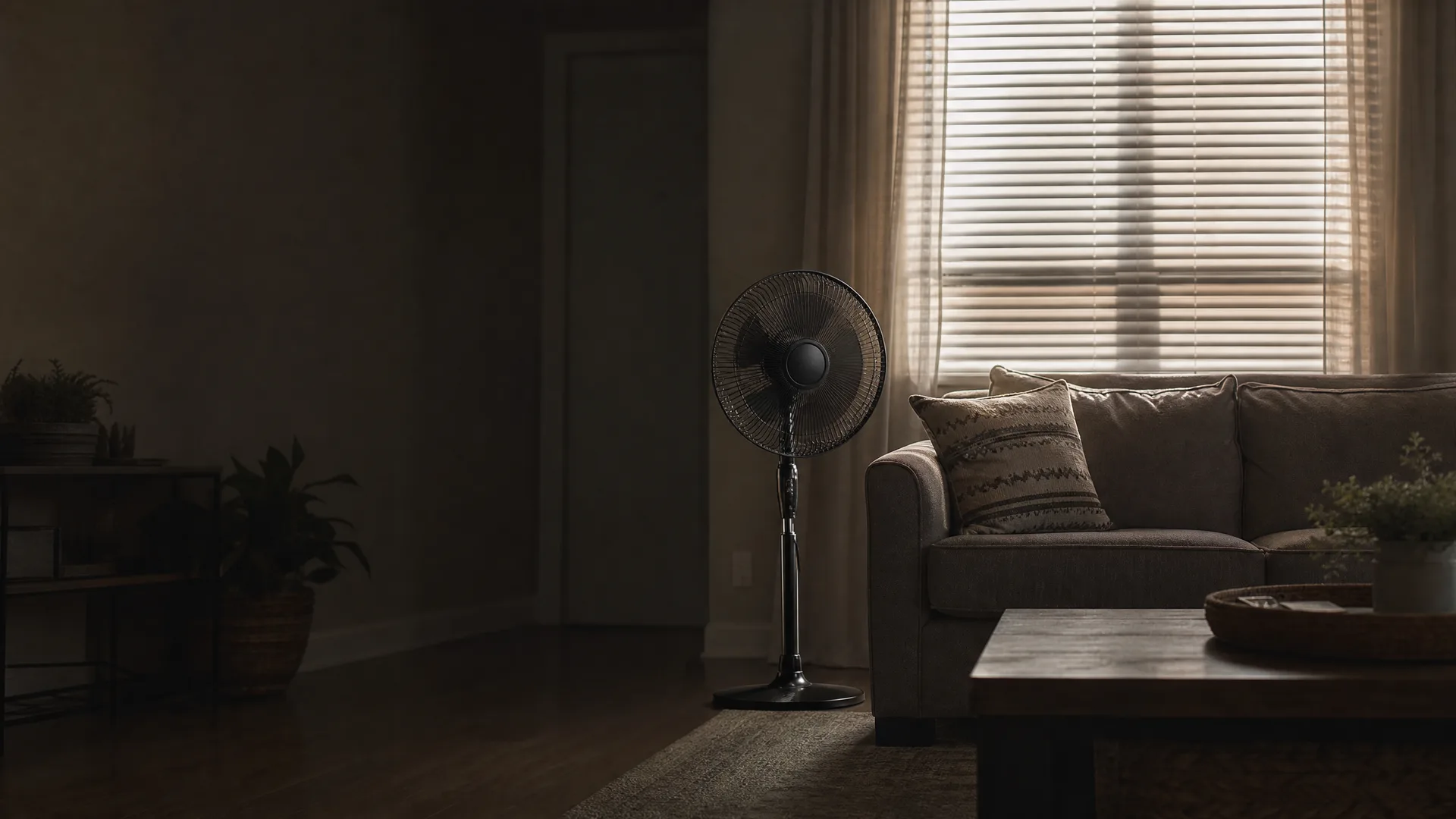
By two in the afternoon you've pulled the blinds against the sun and dragged the floor fan next to the couch, pointed right at you. It pushes the same warm air around the room. The light coming through the blind slats is bright enough to show dust in the air. You've already checked the thermostat twice, like it might read different the second time. Outside, the sun is doing what it does on a July day here, no haze to soften it, just a hard clean light on the siding. Your shirt is sticking to your back. The fan hums along, and every few minutes you notice it isn't helping and you reach for your phone anyway, like something might've changed.
What happens inside the unit when it won't cool
Your outdoor unit has a compressor, which is what moves refrigerant through the system and makes the cooling happen. When the compressor is drawing too much current, a run capacitor stores the extra charge it needs to start. A weak capacitor still lets the fan spin, but the compressor itself might just hum, or not start at all. That hum without a start is one of the clearer signs something inside has failed rather than a setting being off.
Low refrigerant shows up differently. The line running to your outdoor unit will feel colder than normal, sometimes cold enough to sweat or frost over, while the air coming through your vents runs warm. That combination means the system is losing its ability to absorb heat, not losing power. A contractor who knows what they're looking at can tell apart a bad capacitor, a failing compressor and a refrigerant leak in a few minutes, which matters once you're ready to stop guessing and get it fixed.
A unit that's keeping up
Clean fins, a clear pad, lines running straight into the wall. This unit cycles on, runs its course, and shuts off again without anyone thinking about it. That's what normal looks like, and it's worth knowing so you notice when yours stops matching it.
A unit that's been struggling for a while
Dirt packed into the fins and a casing that's taken years of weather don't happen overnight. A unit that's been neglected like this is more likely to trip a breaker or ice over when the heat finally pushes it past what it can manage.
Why does my outdoor unit keep tripping the breaker?
You reset the breaker once and it held, so you flipped the AC back on. Now it's tripped again, maybe twice in an hour, and you're wondering if this is something you should keep resetting or if you're about to burn out something expensive by trying.
A compressor pulling too much current is tripping it
The compressor is the hardest-working part of your outdoor unit, and it draws the most current when it starts. A healthy start capacitor smooths that draw out. When the capacitor is weak, the compressor pulls harder and longer to get going, and the breaker reads that as an overload and cuts power. A low refrigerant charge does something similar, it makes the compressor work against pressure it isn't built for. Either way, resetting the breaker again doesn't fix what's causing the draw, it just lets the same thing happen once more. A breaker that trips more than once in a short stretch is telling you something about the compressor, not about the breaker itself.
Clear fins, open space around the pad, a straight shot of air into the wall. Nothing here is making the compressor work harder than it has to.
Dirt packed into the fins blocks airflow across the coil, and the unit has to run longer to move the same heat out of your house.
Power costs 15.83 cents per kilowatt-hour statewide
At 15.83 cents a kilowatt-hour, a struggling compressor that's drawing too much current or running nonstop to keep up shows up fast on your bill. A unit repaired early costs less to run than one limping along until it fails outright.
EIA-861 2025 statewide residential average
Where You Stand Now
A tripped breaker, a dead thermostat battery, or a dirty filter accounts for a good share of AC calls, and all three are things you can check yourself.
A compressor that hums without starting, a slow fan, or ice on the line set points to a part that's failing, not a setting that's wrong.
Letting a struggling unit run through a hot stretch costs more on the power bill than having it looked at while the problem is still small.
Once you send in the details, you're no longer the one tracking down who's free and who can get to a Minnesota AC in the middle of summer.
A unit that's cycling on current draw it can't sustain tends to get worse, not better, the longer it keeps running that way.
Clean fins and clear airflow aren't the issue if the breaker keeps tripping, that points inside the unit, to the compressor or capacitor.
You started with the easy checks: thermostat battery, breaker, filter. If one of those was the problem, you're already back to cool air. If not, you've got a better sense of what's actually wrong, a compressor that won't start, a fan that's not pulling its weight, ice where there shouldn't be any. That's useful information, and it's the kind a contractor needs to hear before they ever get to your house.
None of this gets better by waiting it out. A unit pulling more current than it should, or cycling on and off trying to keep up, is under more strain each time it runs that way, not less. The breaker that held this morning might not hold tonight. And a struggling system still pulls power the whole time it's running, so the bill catches up to the problem even if you haven't fixed it yet.
What changes once you send in your details is simple. You stop being the one calling around Minnesota in the middle of a hot stretch trying to find someone free. That part becomes someone else's job, not yours. You've already done the part that mattered, you looked at the unit, you noticed what it was doing, and you know more than you did an hour ago. The rest is a matter of getting the right person to the system itself, which is what happens next.
Get the right pro for your air conditioner
After you send the request, you're done searching.