Mini Split Installation in Rochester, MN
A new system here will heat from September through May and cool from June through August every year. Tell us about the house, and a licensed contractor who covers Olmsted County will get in touch.
Tell us about the job
It takes about a minute.
What Olmsted County winters ask of a mini-split
Winter nights here average 10°F, December through February. A mini-split has to pull heat out of air that cold for months at a stretch, not just on the worst week of the year. Summer is milder by comparison, with afternoons averaging 79°F. Homes here need heat from September through May, nine months of the year. Cooling only runs June through August, three months. Between the two, something is running all twelve.
A mini-split installed new has to meet the federal minimum for a split-system heat pump. That means 14.3 SEER2 for cooling and 7.5 HSPF2 for heating. It's a floor, not a target, and it applies whether the unit is replacing an old one or going into a room that never had one. Given how many months this area asks a mini-split to heat, that heating number is worth as much attention as the cooling one.
- 9 months
- September through May, your system heats
- 3 months
- June through August, it cools
- 10°F
- the average winter night it heats against
- 79°F
- the average summer afternoon it cools against
NOAA nClimDiv, 1991–2020 normals
Minnesota has no state license for HVAC contractors.
Minnesota does not put HVAC contractors through a state licensing exam, and it does not keep a state list of registered ones either. There is no state credential to check because the state does not issue one. Whatever protection exists here comes from somewhere other than a license.
For a mini-split installation, that protection is the permit. In most Minnesota cities and counties, putting in a mini-split needs a permit from the local building office, and an inspection once the work is done. The person doing that inspection is checking the installation itself, the wiring, the lines, the mounting, not a license, since there isn't one to check.
Source: Minnesota Office of the Revisor of Statutes
- Is a mini split worth it?
- For a lot of homes here, yes. A mini split gives you a heat pump that handles both heating and cooling from a single outdoor unit, and since this area needs one or the other 12 months a year, that kind of coverage gets used. Rochester winter nights average 10°F, and cold-climate mini splits are built to keep producing heat down at those temperatures, though how well one performs on your coldest nights depends on the model. A contractor can look at your house and tell you whether it makes sense as your main heat source or as backup to what you already have.
- How many rooms can a mini split cover?
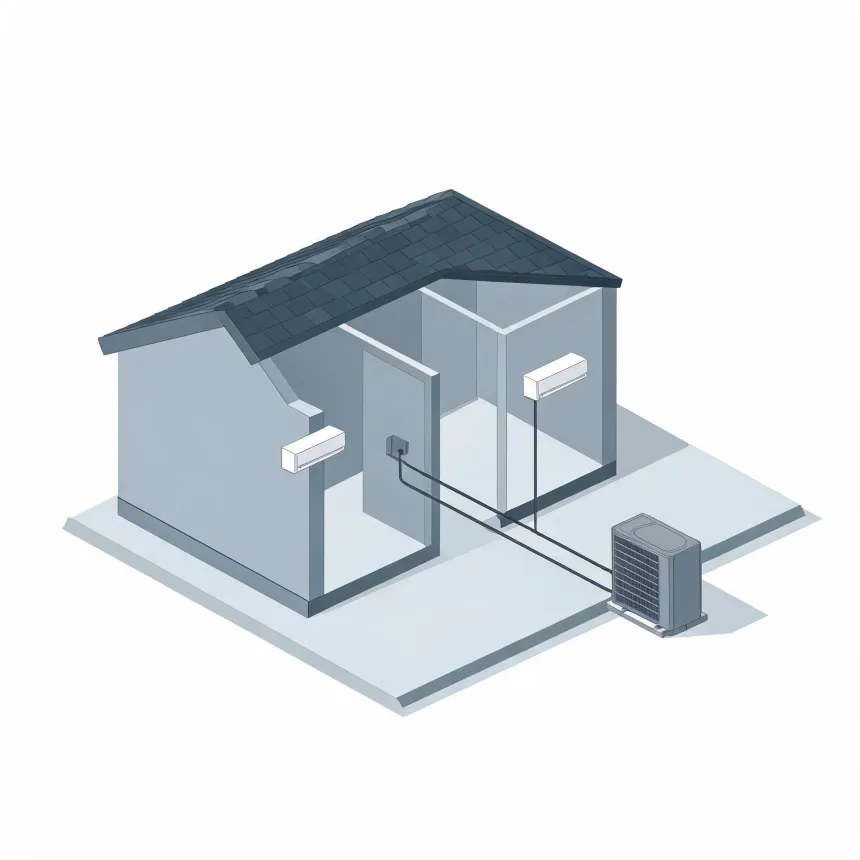
- That depends on the system, not on mini splits as a category. A single-zone system heats and cools one room or open area well. A multi-zone system runs several indoor heads off one outdoor unit, with each head controlled on its own, so you can cover more than one room without adding a separate outdoor unit for each. How many zones your house needs comes down to the layout, and that is a call a contractor makes after seeing the space.
- Can a mini split heat a whole house?
- It can, with enough indoor heads placed in the right rooms and an outdoor unit sized for the whole house. Rochester needs heat from September through May, so the system has to be built for that stretch of cold, including the 10°F nights that show up December through February. Most homes here heat with gas furnaces now, and a whole-house mini split is a bigger design job than adding one or two heads to an existing system. A contractor can size it out room by room and tell you whether it covers the house on its own or works better paired with what is already there.