Mini Split Installation in Blaine, MN
A new system here will heat from September through May and cool from June through August every year. Tell us about the house, and a licensed contractor who covers Anoka County will get in touch.
Tell us about the job
It takes about a minute.
Blaine asks a mini-split to work all year
Winter nights here average 9°F, and a mini-split has to keep pulling heat out of that cold air for nine months, September through May. Summer afternoons average 80°F, so the same unit switches over and runs the other direction for the three months of June through August. There is no real off season here, just a change in which job it is doing.
Any mini-split installed new has to meet the federal minimum for a split-system heat pump, 14.3 SEER2 for cooling and 7.5 HSPF2 for heating. That is the floor a unit facing Blaine's winters and summers needs to clear, not a target to aim for.
- 9 months
- September through May, your system heats
- 3 months
- June through August, it cools
- 9°F
- the average winter night it heats against
- 80°F
- the average summer afternoon it cools against
NOAA nClimDiv, 1991–2020 normals
Minnesota has no state license for HVAC contractors.
Minnesota does not put HVAC contractors through a state licensing exam, and it does not keep a state registry of them either. There is no state record to check on the person doing this work. Whatever protection exists here comes from somewhere other than a license.
For this mini-split, that protection is local. In most Minnesota cities and counties, an installation like this needs a permit from the local building office, and that office sends someone out to inspect the work once it's done.
Source: Minnesota Office of the Revisor of Statutes
- Is a mini split worth it?
- For most homes it comes down to what you're heating or cooling and how. A good cold-climate mini split keeps working at winter nights near 9°F, which is what Blaine sees December through February. If you're adding heat or cooling to a room that doesn't have ductwork reaching it, a mini split solves that without tearing into walls. If you're weighing it against a furnace and central air, a contractor can walk through the specifics of your house.
- How many rooms can a mini split cover?
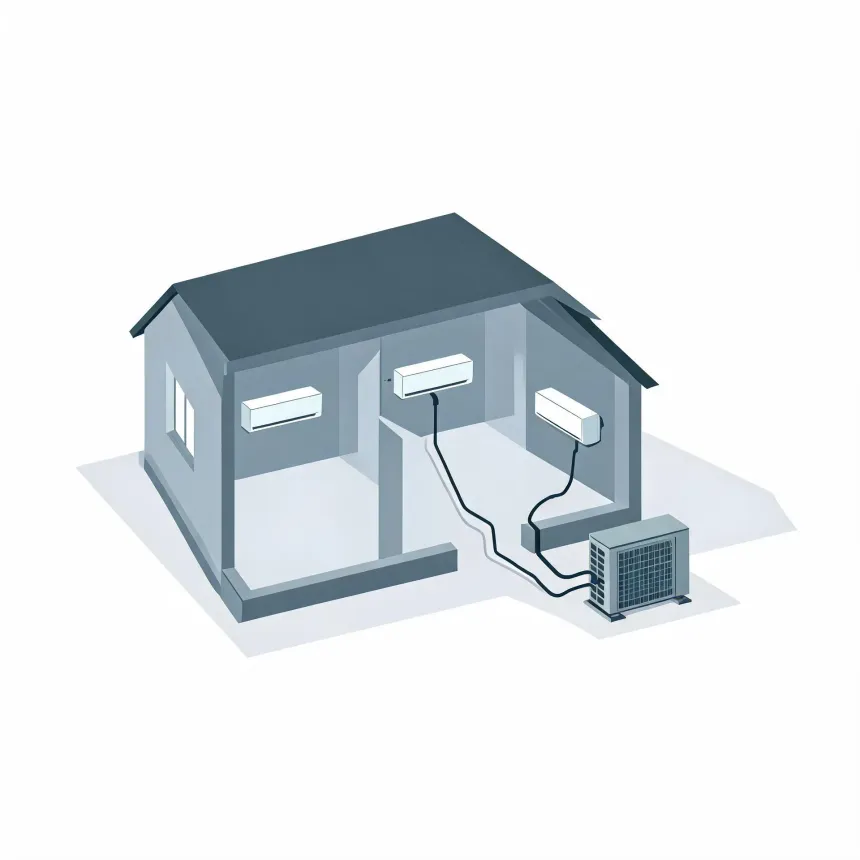
- A single outdoor unit can run one indoor head or several, depending on the system. A single-zone system covers one room or an open area well. A multi-zone system ties several indoor heads to one outdoor unit, so each room gets its own thermostat and can be set differently. How many rooms make sense on one outdoor unit depends on the size of each space and the total load, which is why a contractor sizes this room by room rather than guessing.
- Can a mini split heat a whole house?
- It can, if it's sized and placed to cover every room, but that takes planning. Blaine homes need heat from September through May, nine months a year, with winter nights averaging 9°F, so the system has to be rated to keep working at those temperatures without falling back on backup heat. Most homes here heat with gas already, so a mini split is often added to handle specific rooms or to take over cooling, rather than replacing the whole furnace. A contractor can tell you whether your house layout and insulation make whole-house coverage realistic.