Minnesota HVAC Pros

Signs of mold in your air ducts in Minnesota

A galvanized steel round duct with a 90-degree elbow and a circular louvered vent grille at one end, photographed against a plain light gray background.
Let a pro reach out

A musty smell when the furnace or AC kicks on, dust that keeps coming back no matter how often you wipe it down, and dark specks around the vent covers are the main signs of mold in your air ducts. Minnesota homes seal up tight for winter, and a duct system that's picking up moisture, from a condensate line, a humidifier, or a leak somewhere in the house, has nowhere for that moisture to go. It sits in the ductwork and gives mold what it needs. You might also notice it worse in one room than others, or more anyone in the house with allergies coughing or getting stuffy indoors, when it's clear outside. None of this clears up on its own. The ducts carry air through the whole house, so whatever is growing in them gets pushed into every room, every time the system runs. A musty smell that doesn't fade with a window open is worth checking rather than living with.


Empty basement with bare concrete walls and floor, a steel support column, and galvanized sheet-metal ductwork and pipes running along the exposed wood joist ceiling.
Before you get your ductwork cleaning
Empty unfinished basement with concrete walls and floor, exposed wood joists, metal HVAC ducts and pipes overhead, and a steel support column near a framed wall.
After you get your ductwork cleaning

Mold in a duct system almost always starts with moisture somewhere it shouldn't be. A leaky vent boot, a clogged condensate line, or humid basement air pulled through a return can all supply that moisture. Once spores land on the dust that collects inside duct, they have what they need to grow, and they don't need standing water to keep spreading. The furnace blower then does the rest, pushing air past the growth and out through every vent, which is why the smell seems to come from the whole house rather than one room. If the growth sits near the evaporator coil or in the drain pan, it tends to smell stronger when the AC is running than when the furnace kicks on. Flexible duct holds onto that growth longer than smooth metal duct does, because the ribs inside it collect dust and condensation that smooth duct sheds. And if the liner inside the duct has gone soft or turned dark, the moisture has likely been there long enough that wiping down the surface won't reach what's grown underneath it.


How mold actually gets in

  • Mold needs moisture, and a duct system picks up moisture from a leaky vent boot, a clogged condensate line, or humid basement air pulled in through a return.
  • Once spores land on dust inside the duct, they feed on that dust, so the growth can spread without any outside water source at all.
  • A furnace blower pushes air past the growth and out through every vent in the house, which is why the smell shows up room to room instead of in one spot.
  • Mold growing near the evaporator coil or in the drain pan often smells stronger when the AC runs than when the furnace does.
  • Flexible duct with dust and condensation sitting in its ribs holds onto growth longer than smooth metal duct, since there is more surface for it to grip.
  • A duct liner that has gone soft or dark has usually been wet long enough that cleaning the surface will not solve what is underneath it.
A smiling man in a dark blue T-shirt sits on a light gray sofa in a living room with a wooden shelf and window behind him, with a laptop edge visible in the foreground.
A bearded man in a plaid flannel shirt stands indoors looking out a frost-covered window, with a steaming dark blue mug on the wooden sill and snow-covered trees outside.
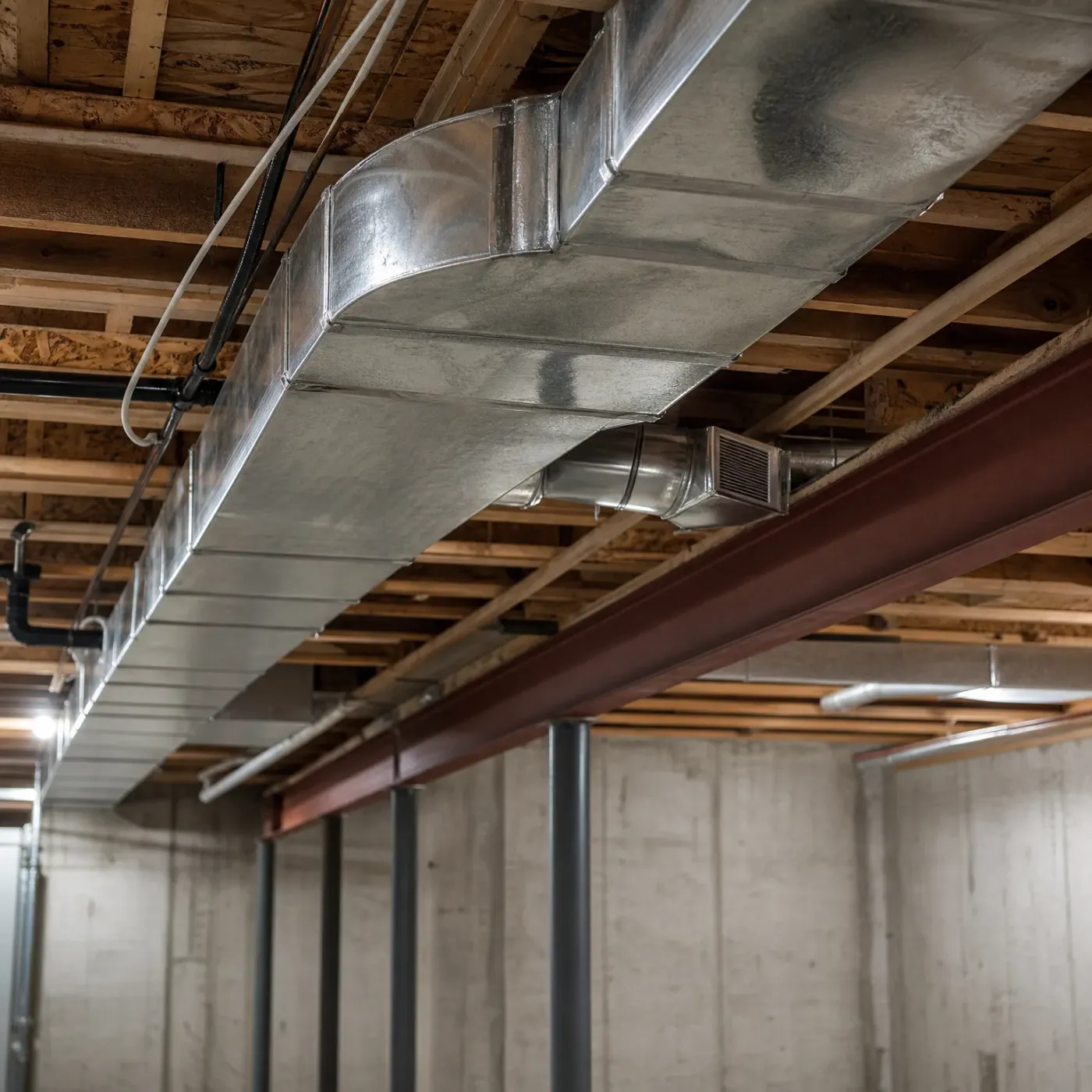
Galvanized sheet metal trunk ductwork with a round branch and register running beneath wood floor joists in an unfinished basement, alongside pipes, wiring, a steel beam and concrete walls.

Finding a pro stops being your job

Skip calling around for someone who cleans ducts.

Send the form and finding a duct cleaner is handled.

Skip the calls

There's no charge for the request.

Unfinished basement with concrete floor and walls, exposed wood joists, steel support posts, and large galvanized sheet-metal ductwork running to a furnace or air handler against the far wall.
Ducts tied into a furnace like this move air through clean sheet metal, with nothing feeding mold along the way.
Galvanized sheet-metal ductwork and round pipes run along a wooden floor joist ceiling above a bare concrete wall and floor.
Ducts running through joists like this trap dust in the seams, and that dust is what mold needs to take hold.

What does mold in your ducts actually look and smell like?

Turn on the furnace and smell something musty before the air even warms up. Check a vent cover and find dark specks clustered around the slats, not just dust but flecks that smudge gray or black when you touch them. Pull the return air filter and notice it's dirty again only a few weeks after you changed it. Anyone in the house with allergies seems worse indoors than outside lately, more sneezing or a stuffy nose that clears up once they leave. None of these alone proves mold is growing in the ductwork, but together they're worth checking, because mold left to spread in the ducts keeps feeding on the dust running through them and keeps circulating into every room the system reaches.

Unfinished basement with bare concrete floor and walls, exposed wood joists, metal ductwork, a furnace unit, steel support posts, and a small window.

A duct system with nothing to catch

The sheet metal here runs clean from the furnace, so dust moves through instead of settling. No seams full of debris, no damp corner for spores to land on. Air just passes through.

Empty basement with bare concrete walls and floor beneath an exposed wood-joist ceiling carrying galvanized sheet-metal ductwork, round ducts and pipes.

A duct run that holds onto dust

Spiral duct through open joists like this has more seams and more surface for dust to collect. Add any moisture nearby and that dust is exactly what mold needs to get started.

Power costs 15.83 cents per kilowatt-hour statewide

At 15.83 cents per kilowatt-hour, running a blower fan harder to push air through moldy, dust-clogged ducts adds up on your bill. Clean ducts let your furnace move air without straining, so you're not paying extra to breathe through a mess.

EIA-861 2025 statewide residential average

A wooden table in the foreground holds a closed laptop and a ceramic mug of coffee, with a spindle-back wooden chair behind it, a beige wall with paneled wainscoting, a window at left, and a kitchen counter with a cutting board, bowl of fruit and greenery at right.

A musty smell or dark specks mean it's time to get the ducts checked

A musty smell from the vents, dust that returns days after you wipe it away, dark specks around the covers. Any one of those is worth paying attention to. Together, they mean mold has a foothold somewhere in the system and it isn't going away on its own.

You don't have to figure out which contractor to call, sit on hold, or describe the smell and the specks over and over to different companies while you compare what they quote you. Send the form and that part is done. Someone licensed to inspect and clean the ducts takes it from there, and you go back to the rest of your day knowing it's handled.


Interior corner of a living room with a beige upholstered sofa and dark cushion in the foreground, a ceramic vase of leafy branches on a dark side table by a curtained window, a framed picture on the wall, and a wood-surround fireplace at right.
A smiling man in a gray long-sleeved shirt stands in a kitchen looking to the side, with open shelves of dishes, a white mug on the counter, a potted plant, and a view through a doorway into a living room.
A smiling bearded man in a green sweater sits at a white marble kitchen island with a mug, potted plant and bowl of fruit, in a bright white interior with open shelving and an arched doorway.
A smiling man with dark curly hair and a beard, wearing a dark green knit sweater, stands at a white marble kitchen counter with a dark blue mug, with open shelving, pendant lights and a houseplant behind him.
A smiling man in a green ribbed sweater stands behind a wooden table holding a ceramic mug of coffee in a kitchen with white subway tile, shelves of potted plants, and a bowl of fruit.

Ductwork Cleaning

Let someone else find the pro

Answer a few questions about the duct cleaning and skip the search.

A black-framed smartphone standing upright against a plain light gray background, its screen filled with solid green.
Duct and vent cleaningDucts or ventsMinnesota
Step 1 of 2

What ZIP code is the job in?