Profile view of a bearded man wearing a black baseball cap and a dark gray T-shirt against a plain light background.

Why your furnace is blowing dust in Minnesota

Tune-up, service, or cleaningFurnace or heatingMinnesota
Step 1 of 2

What ZIP code is the job in?

Why is my furnace blowing dust into the house?

A Minnesota winter means your furnace runs almost nonstop from October through March, and you've noticed more dust settling on the furniture or coming out of the vents than usual. It's enough to make you wonder if something inside the furnace itself is the source, rather than just normal household dust.

A dirty filter or a cracked heat exchanger is pushing dust through your ducts

Most of the time it's the filter. A clogged one stops catching dust and lets it ride the airflow straight into your rooms, and with your furnace running most days from fall through spring, a filter gets dirty faster than people expect. Leaky ductwork can do the same thing, pulling in dust from your attic or basement and blowing it out the registers. Less often, a cracked heat exchanger or a failing blower lets dust and debris mix into the air stream directly. A furnace that runs this many months a year needs its filter checked more often than the box suggests, and if changing it doesn't clear things up, something further in the system is worth a look.

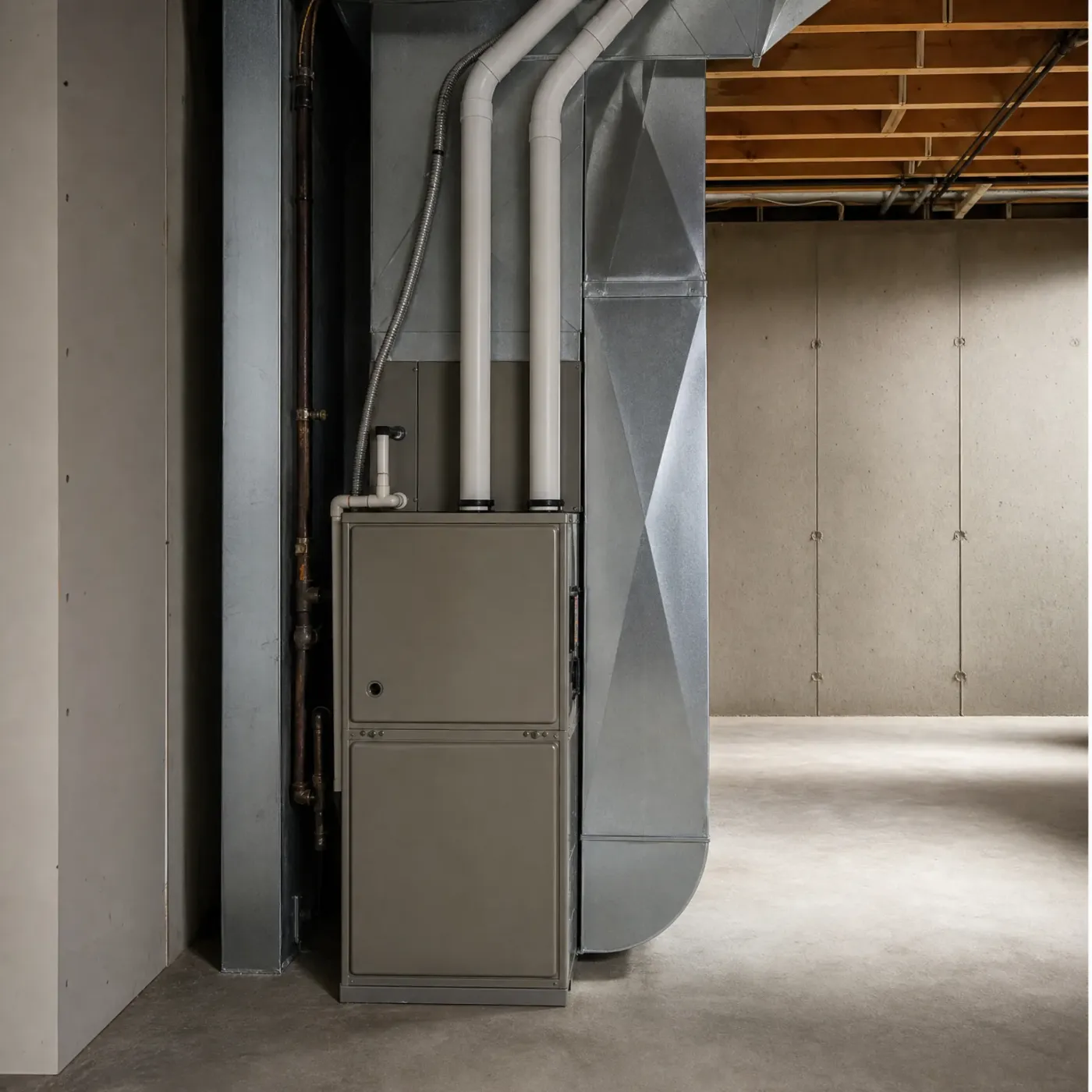
A beige residential gas furnace with white PVC vent pipes, copper and yellow gas lines, and adjacent sheet-metal ductwork stands on a concrete floor beside a plain white wall.

Where the dust actually comes from

Most of what's landing on your furniture isn't coming from the furnace itself. It's dust and dander already in the house, stirred up and recirculated every time the blower kicks on. A furnace that runs almost nonstop from October through March moves a lot of air through those ducts, and a dirty filter or a cracked duct joint lets more of it settle back into the rooms instead of getting trapped.

A gray high-efficiency furnace with white PVC vent pipes and metal ductwork stands on a concrete floor beside a plain off-white wall in a basement.

What a clogged filter does

A filter loaded with dust doesn't stop filtering, it stops letting air through easily. The blower has to work harder to pull air across it, and air finds the path of least resistance, slipping around the edges of a filter that's packed tight instead of passing through it. That unfiltered air carries dust straight into the ductwork and back out through your vents, which is often the real source of the problem.

Filter Swap or Duct Problem

Dirty Filter

  • A filter clogged with lint and dander can't catch what passes through it, so the blower pushes that dust straight into your rooms.
  • You can pull it and check it yourself, and if it's gray and matted instead of white, that's your answer.
  • Changing it on a regular schedule usually clears up the dust within a day or two of running the furnace again.
  • This is the cheapest explanation and the one worth ruling out first before anything else.
  • A filter that's the wrong size or rated too low for your system won't stop fine dust even when it looks clean.

Leaky Ductwork

  • Gaps or loose joints in the ducts pull dust from your attic, basement or crawlspace into the airflow before it ever reaches a vent.
  • You won't spot this by looking at the furnace, since the leaks are often in sections run behind walls or under the floor.
  • Sealing the ducts needs someone who can get into that space and test the runs section by section, not a filter swap.
  • If the dust got worse after work done on the house, like a renovation or new insulation, this is the more likely cause.
  • A technician who works on furnaces in Minnesota homes every winter knows which duct runs in a typical setup tend to separate first.
A beige high-efficiency furnace in an unfinished basement, with white PVC vent pipes, a yellow gas line, metal ductwork, and exposed wood framing on a concrete floor.
A clean furnace sends air through sheet metal ducts and a clear exhaust line, with nothing in the cabinet to shed into your rooms.
An older beige furnace with two louvered vent panels stands on a concrete basement floor, connected to galvanized ductwork and a metal flue pipe, with gas piping and flexible conduit on the wall behind.
A furnace left unserviced builds up dust and rust inside the cabinet, and the blower pushes some of that straight into your ducts.
A furnace in a dim basement with a dirty pleated air filter partially pulled out of its slot, beside a water heater and concrete walls and floor.

You pull the filter out around four in the afternoon, the basement already dim with the early dark that comes on by October. It's gray clear through, matted enough that you can't see light past it when you hold it up to the bulb overhead. The furnace keeps running while you look it over, air pulling past you into the return. You slide the filter back in halfway and stop, thinking about how long it's actually been since anyone looked at this thing beyond swapping a filter. A furnace that runs this much from here to March ought to have someone who knows it check it once before the cold really sets in, someone local who sees this same basement problem every fall.

Matched to your furnace job

Only one pro gets your request, so you hear from one company.

You're not committing to anything by asking.

Just a filter change

If the filter's the only thing gray and matted, swapping it for a new one usually clears up the dust within a few days of the furnace running. No tools beyond your hands, no need to open the cabinet. If the dust settles back down and stays down, that was the whole problem. Plenty of winters in Minnesota end up this simple, especially if the filter had gone longer than it should have between changes. It's worth trying first before you assume something inside the furnace itself is wrong.


Something inside needs a look

If you've already put in a new filter and the dust keeps coming, or the filter was clean to begin with, the problem is inside the cabinet or the ductwork, not something you swap out yourself. That means getting someone who works on furnaces to open it up and see what's built up or come loose. A local contractor who services this equipment every winter will know what usually causes it in a furnace that's run this hard for this many months, and can tell you straight whether it's a quick fix or something more.

An older gas furnace with two louvered front panels stands on a concrete basement floor beside galvanized sheet-metal ductwork, pipes, and a weathered concrete wall.
Before you get your furnace maintenance
A gray high-efficiency furnace in a basement, connected to sheet-metal ductwork on the left and white PVC vent pipes above, with black gas and drain piping and an exposed wood-stud wall with OSB sheathing on the right.
After you get your furnace maintenance

You keep swapping the filter every month and the dust keeps coming back within a week. That's not a filter problem anymore. Something inside the cabinet or the ductwork is feeding it, and no filter schedule fixes that.

A contractor who services furnaces around Minneapolis and St. Paul all winter can open the cabinet, check the blower wheel and the duct connections, and tell you which one's actually shedding into your rooms. That's a look a filter change can't give you.

A gray-haired bearded man in a dark coat and scarf dusted with snow stands smiling in a dimly lit entryway with a white front door, a side table with a lit lamp, an oval mirror, and a patterned rug.
An older bearded man in a dark snow-dusted coat and gray scarf stands just inside a dimly lit home entry, with a framed picture, lit table lamp, and an adjoining room with a fireplace behind him, and snow visible through the open door.
A gray-haired, bearded man in a dark snow-dusted coat stands smiling in a dimly lit entry hall with a staircase, a lit table lamp, a framed picture, and a living room visible through a doorway.
An older man with gray hair and a beard, wearing a dark jacket dusted with snow, stands smiling in a dimly lit hallway with lamps and a living room visible behind him.

Skip maintenance

The furnace keeps running, and so does whatever is shedding into the airflow. You keep buying filters more often and the dust never really stops.

Get a furnace pro

Get it serviced

A contractor opens the cabinet, checks the blower wheel and the ducts near the furnace, and clears out what a filter alone can't catch.

Get a furnace pro
A woman wrapped in a thick beige fleece blanket sits on a sofa with an open book on her lap, beside a lit table lamp, with a frost-covered window behind her.
A gray-haired woman in a cream knit sweater stands in a dimly lit kitchen at night, looking to her right, with a round loaf of bread in the foreground and a dark window and potted plant behind her.
  1. Return air pulls household dust into the furnace cabinet.

  2. Air passes through the filter before reaching the blower.

  3. The blower wheel pushes air across the heat exchanger.

  4. A dirty blower wheel sheds its own dust into the airflow.

Winter nights average 8°F statewide

Average overnight lows here run around 8°F through December, January and February. That's cold enough that your furnace cycles on for most of the night, every night, for three straight months. All that runtime pushes a lot of air through the blower, and a dirty wheel or clogged filter has plenty of chances to keep feeding dust into your rooms.

NOAA nClimDiv 1991-2020 county normals weighted by homes

A dirty filter or a blower wheel caked with months of buildup is what's pushing dust through your vents, and both are things a furnace tends to in regular service. You've got a long heating season ahead, October through March, and a furnace that gets looked at before that stretch starts tends not to cause this problem again partway through. A local contractor who services furnaces all winter in this climate knows a caked blower wheel or a cracked duct connection when they see one, because it's what they're called out for again and again this time of year. You'd be matched with one contractor for your house, not a handful competing for the job, so the person who calls you back is the one who'll actually open the cabinet. Whether it's a filter you missed or something inside the furnace itself, you now know enough to tell which one you're dealing with, and what to ask about when someone comes to look at it.

A gray high-efficiency furnace in an unfinished basement, connected to sheet-metal ductwork and two white PVC vent pipes, with copper piping and exposed wood floor joists nearby.

A local pro for your furnace maintenance

Connect with a pro

A licensed local pro takes the request for your furnace tune-up.

No charge to send it. You decide if you hire them.