Signs your dryer vent is clogged in Minnesota

A local pro who cleans dryer vents gets in touch with you.

Find my pro

A clogged dryer vent shows up first in the dryer itself. Clothes come out hot but still damp, even on a normal cycle, and you have to run it twice to get them dry. The laundry room gets warmer than it should, and you may notice a burnt or hot dust smell when the dryer runs. Lint stuck in the vent line blocks the airflow the dryer needs to push moisture outside, so heat and moisture back up into the machine instead of leaving the house. Check the outside vent hood while the dryer runs. If the flap barely moves or no air is pushing out, the line is blocked somewhere between the dryer and the wall. In Minnesota, a blocked vent also means dryer exhaust and moisture sitting in the house through winter, when you need that warm air going outside, not back into your laundry room.

A pile of beige and navy towels sits on top of a white top-loading laundry machine in a dim room with a dark wall, wood floor, and a wooden shelf holding baskets and a plant.

It's past seven and you're still in the laundry room. The towels have been through the cycle twice now, and they're still heavy and warm instead of dry. You pile them on top of the dryer and press a hand against them, checking. Outside it's a quiet Minnesota evening, the kind of mild night that doesn't ask anything of the furnace yet, but in here the air feels close, almost humid, like the room can't get rid of the heat the dryer's putting out. You open the door to start a third load and catch that warm, dusty smell again. The towels stay where they are, stacked and damp, while you stand there deciding what to do next.


How do I know if it's actually the vent and not just the dryer?

You've checked the lint trap, cleaned it out, and the dryer is still taking two cycles to dry a load. It's easy to assume the machine itself is wearing out, especially if it's been a few years. But the dryer and the vent show the problem in different ways, and there are a couple of things you can check yourself before deciding which one you're dealing with.

Check the outside vent hood while the dryer runs

Go outside while a load is running and look at the vent hood on the wall. Air should push out of it steady enough to move the flap. If the flap barely moves, or you feel only a weak trickle of air, the vent is restricted somewhere between the dryer and the outside wall. If the airflow outside is strong but the dryer still won't dry a load, the problem is more likely the dryer itself, a heating element or a thermostat. This one check tells you which direction to go, and it matters more in winter here, when lint and moisture are more likely to catch and freeze partway down a vent run before reaching the hood.

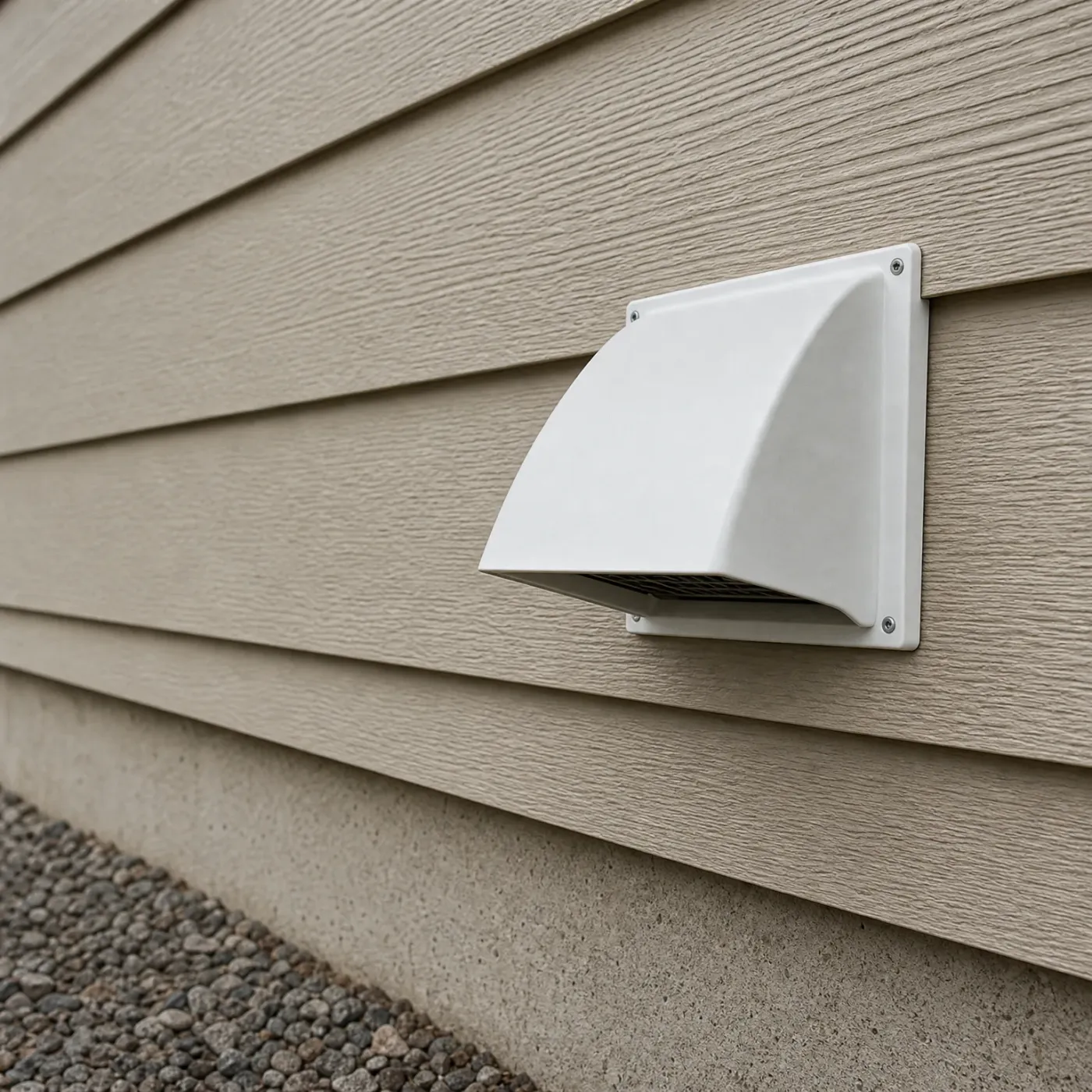
A white hooded dryer vent cover mounted on beige horizontal vinyl siding above a concrete foundation wall with gravel at the base.

Vent clear, hood open

Air passes straight through the hood with nothing blocking it. The flap moves freely and the duct behind it stays open and visible. A dryer vented like this pushes air out fast, so a load dries in one cycle and the exhaust clears the room quickly while it runs.

A square plastic dryer vent hood mounted on light-colored horizontal lap siding above a concrete foundation, with gray lint clogging its screened opening.

Vent packed with lint

Lint has built up across the hood until it covers most of the screen. Air that should shoot out barely escapes, so it backs up into the duct and the dryer. That's what turns a 40 minute cycle into two, and what leaves the laundry room warmer than it should be.

What is your laundry room telling you right now

Stand at the dryer and pay attention to what's in front of you. The top of the machine is hot to the touch, hotter than you remember it being last year. The vent hood outside barely moves when the dryer is running, where it should be flapping with real force. Lint turns up in places it shouldn't, on the floor behind the dryer or caught at the edge of the hood outside. A towel in the load stays damp at the seams even after the rest feels dry. Left alone, a blocked vent makes the dryer run hotter and longer than it was built to, and that heat has nowhere to go but back into the vent and the room around it.

A white plastic dryer vent hood mounted on horizontal lap siding, clogged with gray lint at its lower opening, above a concrete foundation and walkway.
Before you get your dryer vent cleaning
A white plastic hooded dryer vent with a screened opening mounted on gray horizontal lap siding above a concrete foundation and gravel bed.
After you get your dryer vent cleaning
A white hooded exterior vent cover with a screened opening mounted on beige lap siding above a concrete foundation and gravel strip.

The right pro for this job

Your dryer vent cleaning request goes to one local pro.

Your dryer vent cleaning request goes to a local pro who does this work.

Get one local pro

Asking costs nothing, and the choice to hire stays yours.

Clogged Vent vs. Open Vent

Clogged vent

  • Lint builds up inside the duct until the exhaust has nowhere to go, so the dryer pushes hot, wet air right back into the room instead of outside.
  • A load that should take one cycle takes two, and the extra heat stays trapped in the drum longer each time.
  • The outside hood barely lifts when the dryer runs, because there isn't enough airflow behind it to push the flap open.
  • Lint collects around the hood opening and along the outside wall where the duct exits the house.
  • The drum and the top panel run hotter than normal, since the heat has no clear path out.
  • A dryer fighting a blocked vent works harder on every load, not just the occasional one.

Open vent

  • Air moves straight through the duct to the hood with nothing slowing it down.
  • The flap swings open wide as soon as the dryer starts and stays open the whole cycle.
  • A load comes out dry in one cycle, and the laundry room stays close to normal temperature.
  • Lint exits through the hood instead of settling inside the duct or around the outside wall.
  • The top of the dryer stays warm, not hot, because the exhaust clears as fast as it's produced.
  • You can run back to back loads without the room building up heat or a burnt smell showing up.
  1. Lint collects inside the duct walls as every load runs

  2. Airflow slows, so wet exhaust lingers in the drum

  3. The dryer runs hotter trying to push air through

  4. Moist air backs up into the laundry room instead of outside

A white hooded exterior vent cover with a screened lower opening, screwed to beige horizontal lap siding above a concrete foundation.
Open the hood and air moves straight out, the flap lifts fully and the louvers stay clean year after season.
A hooded dryer vent mounted on beige lap siding, with gray lint buildup packed in and hanging from its louvered opening.
Lint has packed the louvers shut, so the flap barely lifts and exhaust has nowhere left to go but back inside.
A woman wrapped in a thick wool blanket sits in an armchair with an open book on her lap, beside a lit lamp and a frost-patterned window.
A woman in a cream knit sweater sits in an armchair with her eyes closed and head tilted back, beside a window showing orange autumn foliage and a wooden side table with a mug.

Power costs 15.83 cents per kilowatt-hour statewide

At 15.83 cents a kilowatt-hour, a dryer working twice as hard to push air through a clogged vent is burning through power on every load. Two cycles instead of one means you're paying for the second run just to finish what the first one should have.

EIA-861 2025 statewide residential average

What a Clogged Vent Looks Like

  • Clothes that stay hot and damp after a full cycle mean the vent is restricting airflow, not the dryer failing.
  • A laundry room that runs warmer than the rest of the house points to exhaust backing up instead of venting outside.
  • A vent hood flap that barely lifts when the dryer runs shows lint has packed the louvers shut.
  • A burnt or hot dust smell during a cycle means trapped air is heating up inside the duct.
  • Running two cycles to dry one load wastes power and points straight at a blocked vent.
  • A dryer that used to finish in one cycle and now needs two has lost airflow somewhere between the drum and the hood.

Put the signs together and they all point the same direction. Heat and moisture that should leave the house through the vent hood are staying put instead, pushed back into the drum and the room because the duct can't move air the way it used to. The dryer isn't guessing at this. It's reacting to a duct packed with lint, running hotter and longer to do what used to take one cycle. None of this means the machine is wearing out. A dryer with a clear vent doesn't need a second cycle to finish a load, and it doesn't leave the laundry room warmer than the rest of the house. When you see two or more of these signs together, the damp clothes, the heat in the room, the flap that won't lift, the smell partway through a cycle, the vent is the common thread tying them together. Checking the lint trap and still getting the same result just confirms it. The blockage is further down the line, somewhere between the back of the dryer and the hood outside, and it builds up the same way in any home that runs a dryer through a Minnesota winter and uses it just as hard in summer. Once you know what to look for, the dryer itself has already told you what's wrong. The next step is getting the duct cleared, not the machine replaced.

A gray-haired man in a dark coat dusted with snow stands in a warmly lit home entryway, with a lamp, sofa, window and white staircase banister behind him.
An older man with gray hair and a beard, wearing a dark coat dusted with snow and a blue plaid scarf, stands smiling in a dimly lit entryway with a window, framed picture, table lamp and staircase behind him.
A gray-haired, bearded man in a dark winter coat with snow on the shoulders stands in a doorway of a home interior with a lit lamp, framed pictures, a potted plant and a staircase behind him, and an evergreen wreath at the left edge.
A gray-haired man in a dark coat with snow on the shoulders and collar stands smiling in a dimly lit entryway with a paneled front door, lamps, and a framed picture in an adjoining room.

Dryer Vent Cleaning

Matched to your dryer vent job

The pro who reaches out is licensed in Minnesota.

A smartphone with a blank green screen stands upright against a plain light gray background.
Duct and vent cleaningMinnesota
Step 1 of 3

What kind of equipment?